When it comes to our understanding of science, it is from speaking to one another, reading one another, that a more clear understanding of science appears. Unfortunately, with the advancement of social media and mass communication, it seems that with every new discovery in science, the gap between its understanding among scientists and the wider public is widened. This makes it hard for individuals to address societal challenges and ensure the scientific discoveries of today can indeed be on its way to helping whoever that needs it.
In order to effectively share science, scientists must not only be good researchers but also good writers, artists, and storytellers. My immunology teacher told me that the key to promoting science literacy en masse is to use the ABT format, which favors science communication centered around solving problems instead of a straightforward chronological order presentation (the AAA format). In the first place, this is a recognition of keeping the public hooked to the facts: why this science is important, what issues it solves, and what benefits it means for their respective lives. I believe that is science’s greatest contribution: the promise to solve societal problems.
Breakthrough Junior Challenge
The Breakthrough Junior Challenge is an annual, global science video competition for high-school students. I competed in this competition three times (2022, 2023, and 2024) with three videos focusing on eating disorders.
The best perspective I can offer on a deep science topic as a student is from my everyday experience with the world around me. All around me are my family, friends, and food. One thing that is very prevalent among young people is eating disorders. According to the National Eating Disorder Association, 13.2% of girls will show eating disorder symptoms during adolescence and 0.3% of young women and 0.1% of young men will suffer from anorexia nervosa, yet these numbers have narrow definitions that don’t entirely reflect the range of eating disorders.
Many societies today amount beauty to weight and people are often pressured to diet for reasons other than health or happiness. That’s why, as someone who is fixing my own eating habits as well, it is paramount that we pay attention to what we eat so we can better take care of our bodies from the inside out. Eating disorders are biopsychosocial, meaning they are deeply woven into your body, mind, and society, making this illness hard to treat. I have many friends who’ve had eating disorders, but with the proper help, they turned their relationship with food around. People CAN make a full recovery. I hope my videos help erode some of the stigma surrounding eating disorders because education about them is one of the most effective ways to spread love and support to those who need it.
Through exploring life sciences, scientists can understand what we are capable of in the future from our past and work to improve the present. Life sciences are one of the only sciences in which everything in the world has ties to and can be traced to their fundamental roots, no matter their place in history. It also tends to be one of the most relevant science topics for people today, because though topics like physics or math are not obviously visible to the naked eye, everyone can feel life sciences through our bodies.
I believe life sciences are important precisely because it is the closest option we have to create breakthroughs that will enrich people’s lives directly. This sense of familiarity we have with life, and thus life sciences itself, creates a free space for curiosity regardless of one’s prior knowledge on the topic. We have the responsibility to do something beneficial for the people rather than have the people do something for us. These unique characteristics allow the scientists of today to explore life sciences at an intimate level and become closer to creating a better condition of life for all mankind.
World Laureates Forum US Youth Representative
With my science communication contributions and enthusiasm, I was selected to attend the 4th World Laureates Forum (youth division) in Shanghai, China, as the only US Youth Representative. In 2022, I was again selected to attend.
Research Intern
I am an intern at UNC-Chapel Hill School of Medicine studying cardiology at the Qian Lab, supervised by Dr. Li Qian. I conduct and review research literature about fibroblast reprogramming and cardiology, lab foundations, and writing analyses.
Curious Science Writers (cSw)
Curious Science Writers (cSw) is a national yearlong program that teaches high school students about science communication through guest speakers, in-person visits to National Institute of Science-affiliated institutions, and writing their own stories about a biomedical science topic in the cSw online journal. I was selected to be a part of its 2024 cohort.
My first story written for cSw was on T cell and B cell epitope prediction using bioinformatic tools. To help write the science for this story, I was able to schedule and conduct and interview with Dr. Alessandro Sette, a leading professor of immunology and researcher in epitope prediction at the La Jolla Institute of Immunology in San Diego, California. This story is currently in its editing and publishing stage.
Broad Street Scientific (NCSSM scientific journal)
At the Broad Street Scientific (BSS), I serve as the physics editor, where I read the student submissions of their research papers in physics, select some to be published in our journal, and work with the authors to edit their work. Additionally, I also wrote a science essay using the global positioning system (GPS) as a scientific tool to combat climate change, which won first place in the BSS Science Essay-Writing Contest and was published in the journal as well.
Women in STEM
How I got interested in physics is a long journey. In middle school and the first half of high school, I thought I was just a biology girl. I made a vow to never touch physics again because of an unsavory exam grade. But coming to my current school, the North Carolina School of Science and Mathematics (NCSSM), challenged that resolution. It was like the stars said verbatim: you will cross yourself.
I realized this STEM school was the culmination of geniuses, who fight to get into our research groups every year. At a club fair, while I too was interested in the research in biology group, there were too many girls swarming the biology table. I ended up chatting with the physics research group the whole time as the only girl there. Cut to today, I have joined the school’s most difficult group, that physics research group. Although our research spans lots of topics, I am very thankful to be conducting my climate research and being inspired by them.
My classmates say that physics courses are the hardest in the school, yet I took two physics courses in the same semester. Yet, I loved it. How could E&M, both electricity and magnetism being things my eyes can’t see, be so interesting? Thanks to my teacher Dr. Falvo, I realized physics was actually interesting if you realize that it applied everywhere, from animate and inanimate objects to the weather to modern technology and more. He taught me to calm down and think about physics (E&M specifically) as not a tricky concept, but as a transferable story to our own lives, which made learning physics a lot easier. Before this class, I was seeing E&M through integrals and formulas. Now, I see it as the space constantly flowing through all of our bodies. When I run up nine flights of stairs for my morning physics classes, I do so with not dread, but excitement.
I know many students look at physics as something annoying and impossible, but I dare to challenge that assertion, as someone who once thought that way too. Thus for a subject I vowed to hate, I came to love.
To shine in a field where people say it wouldn’t be possible for girls, I urge them to look through a clearer telescope. The late Justice Joan Ruth Bader Ginsburg once said, “Women will have achieved true equality when men share with them the responsibility of bringing up the next generation.” I dare to consider this future, not because I am young, but precisely because it has not been done yet. I’m excited to continue seeing what women can do and I’m proud to be a woman in STEM.
Robotics
The first club I joined at NCSSM was the FIRST Robotics Competition (FRC) robotics team, Team 900 The Zebracorns. As the Outreach Lead & Chief Media Officer, I organize outreach events for the team with other local FRC teams and institutions like public libraries. When I’m not writing emails or essays for the FRC Impact Award competition, I can be found trailing our drive team at robotics competitions with at least three cameras, a microphone system, tripod, a huge tablet, and wearing a lanyard that says “Media.”
To take advantage of NCSSM’s nature as an admissions-based school with a quick student turnover rate, Team 900 is a community team comprised of 80+ students and mentors from all over the state. This means we are welcome to anybody who is interested in joining, and other than being a high school robotics team, we also represent NCSSM as a professional institution in our competitions and community events.
In the 2023-2024 FRC season, Team 900 participated in competitions uplifting female and nonbinary STEM students and have kickstarted educational summer programs (in partnership with the NCSSM engineering department) teaching K-12 students about introductory robotics. The Impact Award is FRC’s most prestigious award, and one of my main jobs as outreach lead and chief media officer was to document our team’s community impact, write essays about it, and direct/produce a video showcasing the team’s work to judges. This season, we won the Impact Award at the district level and was a finalist at the state championship.
Science Olympiad
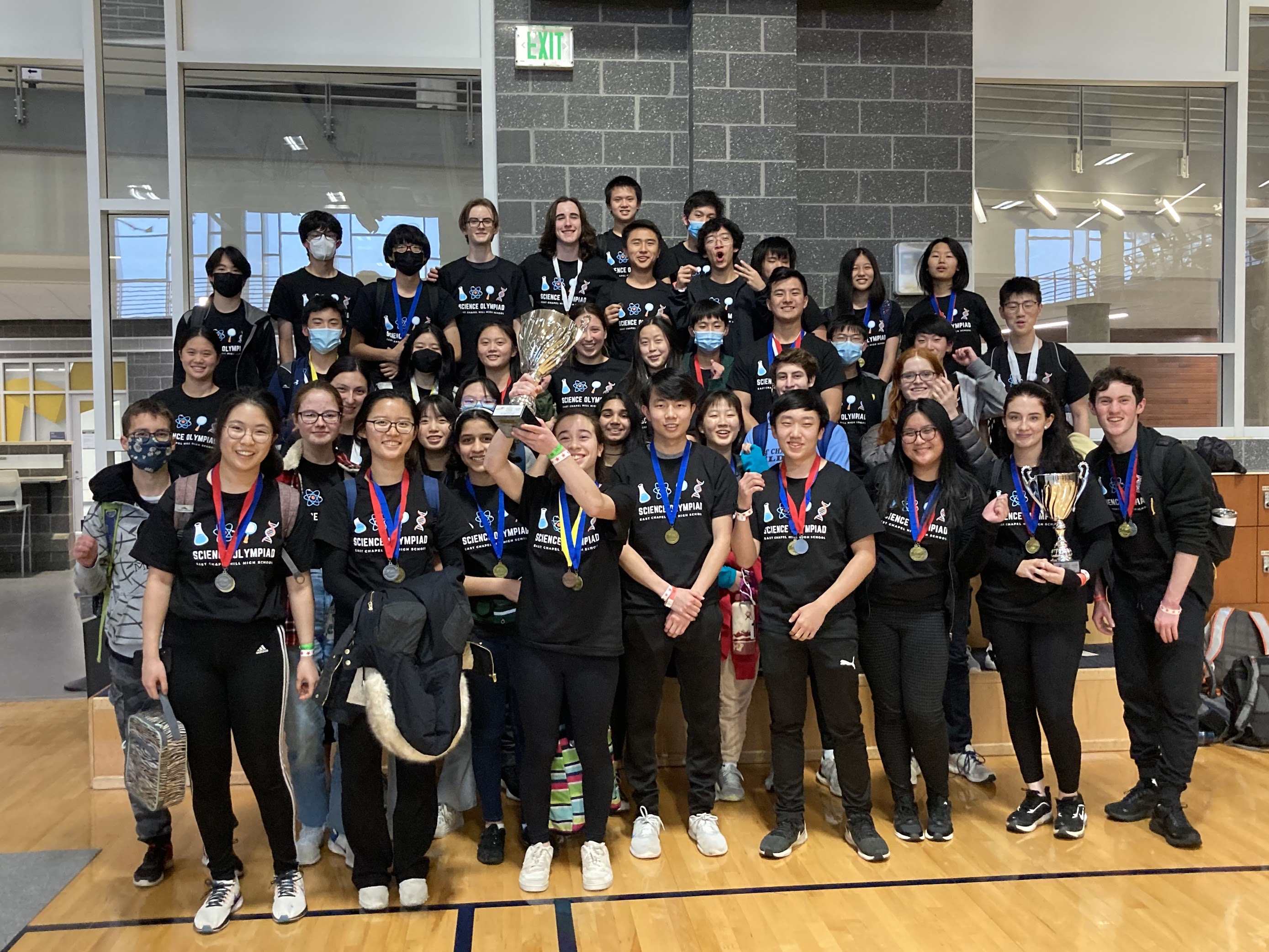
I owe my beginning interest in STEM to Science Olympiad in middle school. At it for six years, it has influenced both my decision to study life sciences and conduct research in physics, and introduced me to the research process. Most events were partner-events, so I also learned how to work together and win as a team.
I studied a broad variety of topics, for example, Road Scholar, Fossils, Cell Biology, and most especially, Remote Sensing. I compiled more than a hundred pages of notes for Remote Sensing, so I was always able to keep my streak of gold medals in the event. In total, I won 20 medals, including district and state-level ones. When I arrived at NCSSM, I turned my passion for that event into a research topic.
 Teresa Fang
Leave a Reply